Cleveland Museum of Natural History
Creating with Care: Craft, Conservation, and Innovation

The Cleveland Museum of History recently underwent a sweeping transition over multiple years that redid the entire museum, and we are proud to have been the exhibit fabrication partner for this exciting project.
In December 2024, the museum opened 375,000 sq ft. of new and expanded spaces that tell the unified story of Earth, shining light on its astounding past and present and encouraging all to work towards a more sustainable future.
We were originally hired to be the exhibit fabricator, our role in the project extended well beyond the fabrication contract. In addition to delivering high-quality exhibit components, we oversaw the majority of conservation services, including taxidermy, paleo object preservation, and the production of natural history models. This comprehensive scope of work reflects our capacity to manage complex, interdisciplinary deliverables that directly support curatorial and interpretive goals.
The CMNH Transformation Project stands as a testament to what’s possible when creativity, innovation, and strong social values converge. Achieving LEED Platinum status, the project prioritized sustainability at every level, from facility construction to exhibit development.
Our team collaborated closely with CMNH to ensure that sustainable materials were integrated not only into the building infrastructure but also into the exhibit environments themselves. This included thoughtful selection of low-impact materials, energy-efficient lighting, and environmentally responsible fabrication methods.
Beyond sustainability, our approach was rooted in respect for cultural and scientific integrity. Sensitive objects, ranging from taxidermy to paleo specimens, were treated and displayed with the utmost care, balancing conservation standards with interpretive impact. This reflects our commitment to social responsibility, ensuring that exhibits honor both the communities they represent and the audiences they serve.
Innovation was also central to our process. From custom-designed mounts to immersive storytelling techniques, we brought creative solutions that enhanced accessibility, engagement, and educational value, making the museum experience more inclusive and impactful.

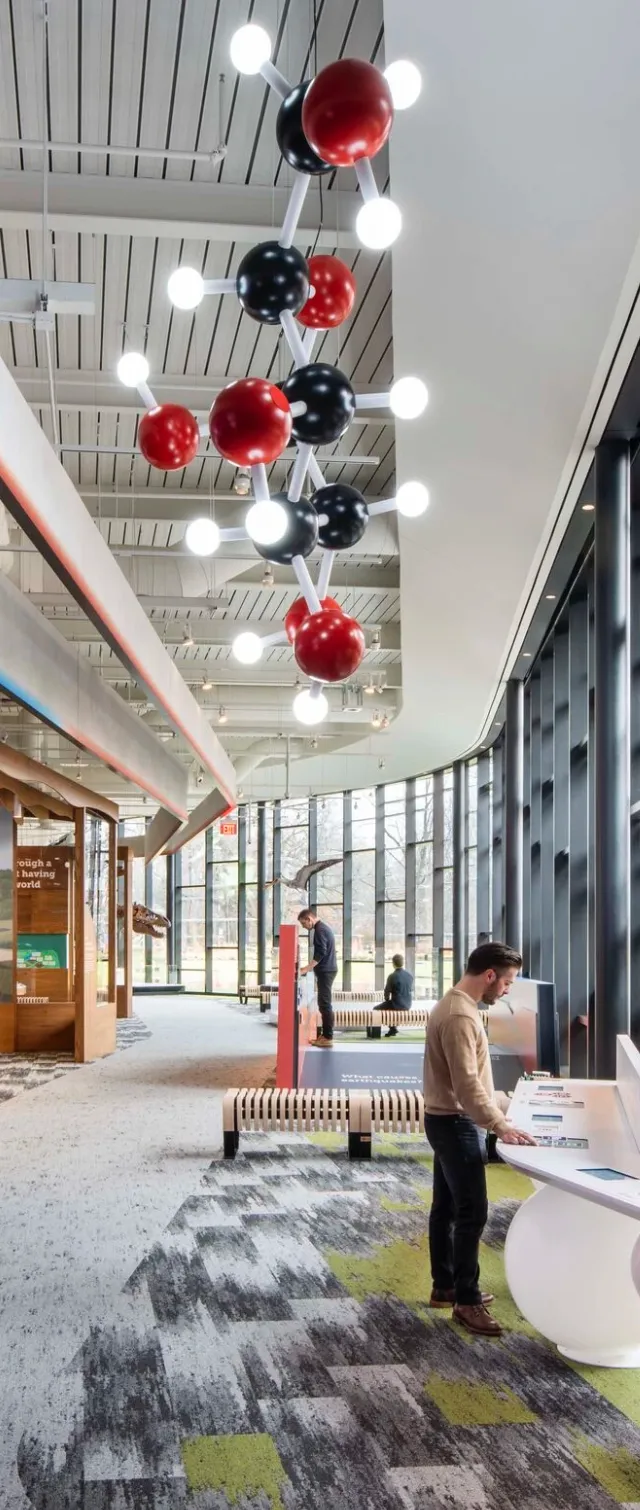


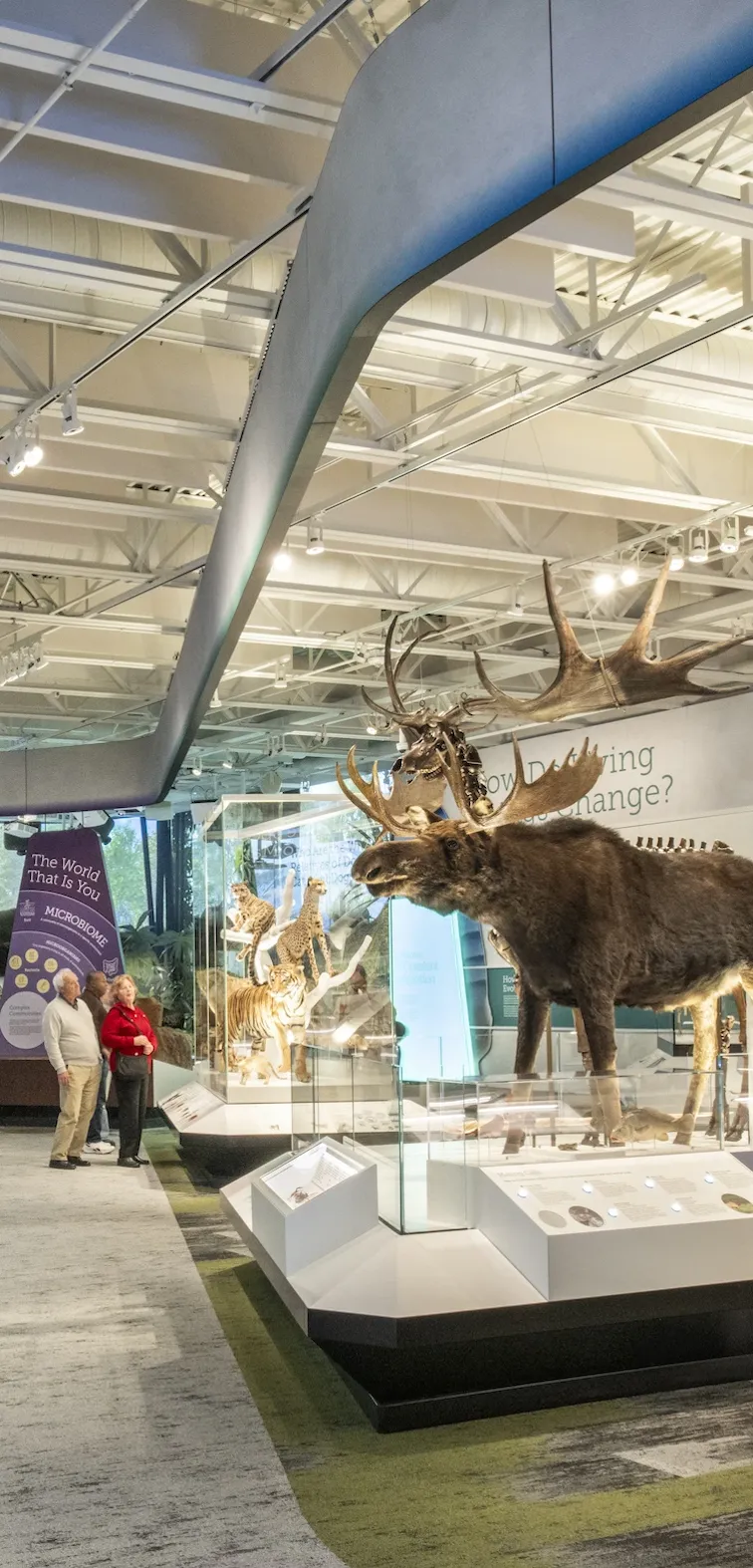
The journey of bringing this project to life was defined by complexity, collaboration, and creativity. A perfect example of this can be found in the large artifact platforms found throughout the entire museum. The platforms themselves presented a formidable engineering challenge: integrating wood, solid surface, glass, and metal into precise geometric forms required not only technical expertise but also a deep understanding of material behavior and fabrication constraints.
Beyond the structural intricacies, the platforms had to accommodate a wide range of elements, casework, taxidermy, large paleo specimens, diverse graphic types, layered lighting (under-platform, in-case, and overhead), as well as AV and interactive components. Each layer added complexity, demanding careful coordination across disciplines.
Despite these challenges, the project team shaped the journey with agility and intention. Through detailed planning, iterative problem-solving, and a commitment to excellence, the team overcame obstacles and set a new standard for integrated exhibit environments. The collaboration across detailing, fabrication, and installation was not only effective, it was exemplary.
In the end, the platforms are both beautiful in form and fantastic in function. They stand as a testament to what’s possible when design ambition meets engineering precision, and when a team leans into complexity with confidence and care.
Partners
G&A
Click
Huettinger
RCI
Triebold
Pangea
Chase Studio
Images
Kevin G Reeves

An international network over 100 years in the making.
Museum Studio is the world’s biggest studio offering turnkey cultural services for institutions, museums, foundations and brands.